Showing posts with label Asia. Show all posts

Wednesday, January 2, 2019

3 days in Singapore

Gardens by the bay
My wife and I recently did a 3 day layover trip to Singapore on our way back to the US from Mumbai, India. Singapore started a Visa free transit facility for India passport holders a couple of years back, so as long as you hold a valid visa for countries such as US, Canada, Japan etc. you can visit Singapore, for up to 96 hours, while in transit, once only i.e while in transit either to your destination, or back to your origin; but not both ways.
Malaysian Cuisine at
Ipoh Lou Yau Bean
Sprouts Chicken
World's tallest indoor waterfall 
We landed in Singapore, after a overnight flight from Mumbai, at around 8:30 am. The immigration was relatively quick, as I presented my US visa and my flight confirmation from Singapore to Kansas City. After immigration, we got our 3 day MRT tourist pass, and were on our way to our hotel, in the Chinatown area of Singapore.
Day 1: We reached our hotel, after a couple of connections on the train and a bus, at about 10 am. However, we were told the check-in was at 3 pm, so we ended up staying, and freshening up & catching up on some sleep, at another hotel which offered rooms at $50 SGD for 3 hours.
After checkout at around 2:30 pm we headed back to our original hotel for check-in.
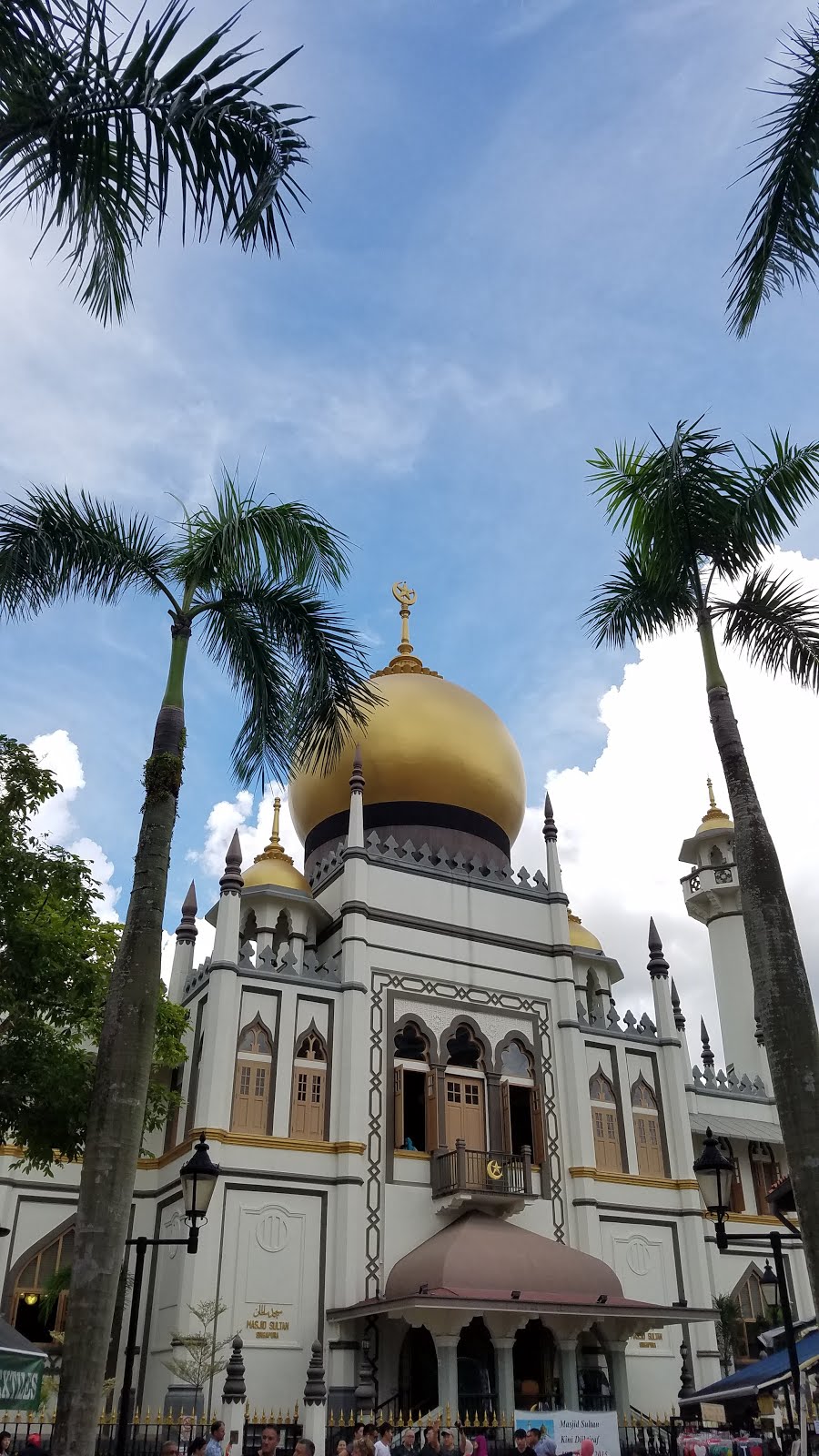
Masjid Sultan

After getting settled into our hotel, we headed out to the Gardens by the bay, a huge, colorful, futuristic park in the bay area of Singapore.  The famous Supertree structures offer an impressive skywalk over the gardens, over-sized seashell-shaped greenhouses recreate chilly mountain climates and there are hundreds of trees and plants to discover, making this destination great fun for both kids and adults.
Supertree walkway

Day 2: The next day, we started with a trip back to the Gardens. This time to see the 2 attractions - Cloud Forest and the Flower Dome. They are both indoor glasshouse like environment with various plants and other tropical habitat. The cloud forest also has the world's tallest indoor waterfall at 35 meters.
Merlion
We ended the visit to the gardens with a trip up the Super tree grove walkway.
We continued our itinerary by moving on to Arab street and little India, and rounded off the evening with a visit to the Merlion park in downtown, a ‘must-see’ for tourists visiting Singapore.  The fish body represents Singapore's origin as a fishing village when it was called Temasek, which means "sea town" in Javanese. The lion head represents Singapore's original name—Singapura—meaning "lion city".
Lunch at Arbora
Day 3: Our last day of Singapore was focused on the Sentosa Island. We had booked an unlimited cable car rides + 2 attractions pass for about $56 SGD/person. There are 2 lanes Mount Faber Line and the Sentosa lane for the cable car. We took both lines to reach the end point of the island which was the Siloso Point Station, which used to be a fort during WWII for the British. There is a wonderful s ky walk (free) to get to the fort.
View at Mt Faber view point
After taking lunch at Arbora near Mt Faber, we went to the view point where you can get a glimpse of the Singapore vastness as a concrete jungle.
As evident from the pic on the right, it started raining almost immediately as we left the viewpoint, so we had to wait and admire the beautiful Singapore rains the next hour or so. We wrapped off our day with visits to the beach, and the southernmost point in contiguous Asia. On the way back we visited the Buddha tooth relic temple in Chinatown, before calling it a day.
Buddha Tooth relic temple
Singapore is much more than the summation of its numerous attractions. It's truly a city that is at least 10 years ahead of it's time, and it advancing at a rapid pace. It's a great place to explore even on a limited time and budget, and I hope this inspires you to visit this magnificent city.


Tuesday, December 15, 2015

Hello Hong Kong!

My wife and I recently did a 3 day stopover trip to Hong Kong on our way back to the US from India. A democratic special administrative region within communist China, Hong Kong is very different from the mainland. A former British colony, which is reflected in the fact that almost all signs in the city are tri or at least bilingual, the main language spoken here is Cantonese, unlike mainland China, where the primary spoken language is Mandarin Chinese.
Hong Kong from the Victoria harbor

Day 1: We landed at around 7 am local time at the Hong Kong airport, after completing the immigration at the airport and exchanging a few USD for
HKD, we met a relative of mine, who lives there and he took us to his place, as our hotel check-in was not until 2 pm and we needed a place to freshen up and store our luggage until check-in.
We left our temporary abode and we were guided by my uncle to nearest station (i.e Kowloon) for our train to Tian Tan Buddha, commonly
The barely visible Buddha
known as Big Buddha. It took us about an hour by train and then 20 minutes by the NP 360 cable car to get to the Ngong Ping village where the Buddha is located, however, unfortunately, due to the rainy and foggy weather, we could barely see the Buddha or the monastery in the small village. We returned back to our hotel late afternoon, a little disappointed.
Evening, although it continued to rain steady, we decided to go ahead with our Hong Kong after dark tour, with our guide Danny. He showed us how the city landscape, including the markets, parks, intersection etc. look during night time. We felt it
was a nice introduction to city. We ended the tour with a view of the skyline form a secret vantage point near the Victoria harbor. By that time, it had stopped raining and we were able to take some good photos of the views on offer.

The SoHo escalator 
Man Mo Tao temple
Day 2: Next morning was a refreshing change from the dull and drab rainy day we had seen the day before. It was bright, albeit a little cloudy; but no rain, which was a welcome relief. We had booked the 10 a.m Old Vs New Hong tour with Danny through Urban adventures, and he promptly met us at the designated spot on the South Hong Kong island. Danny walked us through Hong Kong’s journey from traditional fishing harbor to international financial powerhouse, exploring the pathways of Hong Kong’s historical transformation through its multicultural neighborhoods. We first went through the Hollywood neighborhood (the name actually comes from the fact that the area had a lot of Holly trees when it was discovered first by
Clock Tower
the British), home to many of Hong Kong's elitists.

Next stop was a  a former black market turned open-air curio market, called Cat street. This is because, apparently in Cantonese, the thieves are called "rats", and those who buy from them are called "cats". Our next stop was the PMQ, which used to be the Queen’s College and Police Married Quarters before, and now is a hub for design and creative industries. Its buildings have been retained, reinforced, refurbished and upgraded for new uses. Residential units have been converted into design studios and shops, offices for creative enterprises and lodging for visiting designers.

Our last stop was the SoHo district of Hong Kong, which has the world’s longest outdoor escalator. We round off the morning by a visit to the IFC 2 tower, in the central district, where there is a viewing gallery on the 56th floor, free for visitors.

Evening, we met up with my uncle, who took us to watch the light show at the Victoria harbor. We ended the night by having a Hong Kong special sea food curry dinner at one of the restaurants he took us to.

Skyline from the peak
Cable car to the Buddha
Day 3: Our last day in Hong Kong, was by far the brightest and sunniest. We took this opportunity to ride to the Victoria Peak to catch a full view of the skyline. The journey involved changed a train and a bus ride to get to the bottom of the hill. And then a tram to get to the peak. However, the view from the peak is one of the most amazing things I've seen yet. The photos don't do justice to the sight from the top. On one side you have the world's tallest and widest skyline spread across two islands and on the other side, you have the pacific ocean with green hilltops, which make you forget what's on the other side of the viewing gallery.
The monastery as seen from the Buddha
The Big Buddha

Next, because of our disappointing visit first time and the amazing weather that day, we decided to give the Big Buddha a second visit. And indeed it was worth it! This time we caught a glimpse of the giant Buddha from the cable car itself as we approached the hill top village of Ngong Ping. We spent about a couple of hours exploring the Buddha, the monastery and the surrounding areas of the village. We wrapped up our visit with some bean curd, which is made from soya and mountain water.

10000 Buddhas Monastery 
This brought to an end our exciting three day trip to Hong Kong. If we had more time, we would've done the day trip to Macau and may be a trip to Ocean park, but we'll reserve that for the next time.

Tips: 1) Use the MTR octopus 3 day/ 5 day pass for unlimited travel on the train or the bus.
2) Exchange the Hong Kong dollars at the local dealers in Kowloon. Not all of them have good rates, so look around for the best rate. Else, the ATM card has the best rate, but you end paying a surcharge to the bank, it would make more sense of a large one time withdrawal.
3) Eat local/street side; we really enjoyed the taste and it's relatively cheaper. Make sure you know how to use chopsticks though, as forks/spoons are tough to get in these establishments.

What businesses did we use?
Flight: Air India (BOM-DEL-HKG)
Tours: Hong Kong after dark and Old vs New Hong Kong
Hotel: Kowloon Mongkok 1812 Guest House

Sunday, January 4, 2015

Merhaba Istanbul

The Blue Mosque
Istanbul from the Bosphorous
I recently traveled with my wife to Istanbul as a 3 day stopover on our way back to the US from India, after marriage. As an Islamic country that lies at the cusp of Europe and Asia, it's culturally very intriguing.
The VISA for getting into Turkey for Indian citizens is simple and can be done electronically, condition being that you already possess a valid VISA from the US, the UK or any Schengen country. The officer at the port of entry in Istanbul barely looked at the Turkey and US VISAs and almost immediately stamped our passports.
Hagia Sophia
The dome at Blue mosque
The ride from the airport was a swift one, since we drove at around 11 a.m on a weekday, but the traffic can be dense during peak office hours. Roads along the coastal routes in Istanbul are

very scenic, as you get to admire the beauty of two continents, across the Bosphorous strait.

Day 1: We started off the first day next morning, as I was sick the day we landed and rested almost the entire day. The first sights on the lists were the Sultan Ahmed aka the Blue mosque and Hagia Sophia.
Both religions represented at Hagia Sophia
Built in the early 1600s, the blue mosque is a classic example of the Ottoman empire architecture. It's called 'blue' by the westerners because of the blue turquoise color tiling inside the mosque. Also, blue is considered as an important color in Islam. At the other end of the mosque across a very well maintained garden, is Hagia Sophia. A former Greek orthodox church, later a mosque and now a museum. Built in 537 AD by the Byzantine empire, it was later turned into a mosque by the Ottomans in 1437, and recently in 1931 into a museum by the Government of Turkey, to end the religious debate.
As a result, the insides of this building have both Islamic and Christian traces from their respective pasts.
View from the Bosphorous bridge
Evening, we decided on doing a 2 hour sunset cruise across the Bosphorous. They start at the coast near Blue mosque and go along the way to the Asian side before dropping you off at the same point. The cruise is awesome for getting panoramic views of this magnificent city and it's important landmarks including the mosques and palaces.
Entrace to the Topkapı palace
Day 2: Next day, we decided to do the "Big bus" tours of the city. A 48 hours pass costs about $38 per person, and they provide audio guides and WiFi while on the bus. The bus has two routes, one that takes you through the modern landmarks of the city and the other one that takes you across to the Asian side of the city over the Bosphorous bridge.

Day 3: The last day, we decided to do the tour of the Topkapı palace, which is walking distance from the mosque.
Inside the Topkapı palace
The Topkapi Palace functions as a museum and only a very small part of its original domain and environment can be seen. Over time there has been destruction (by fire) and the demolition (through new building) of many of its original structures. Despite this, the original 15th century spatial organization based on a triple courtyard has remained remarkably intact.

View from Topkapı palace

Tips:
  • Try booking a hotel near the Blue mosque area as all the main attractions are walking distance from there.
  • Exchange USD for Liras rather than Euros to get a better rate, or even better use credit cards where possible, as they have the best exchange rates.

What businesses did we use?
Hotel: Sultan house
Airlines: Turkish Airlines (direct flight from Mumbai to Istanbul)
Tours: Big Bus Istanbul